

Posts and stanchions
Steel posts for noise barriers, fencing and cladding, in sockets, on base plates or in bored piles. Spacing, plumb and level get surveyed and then rechecked post by post.
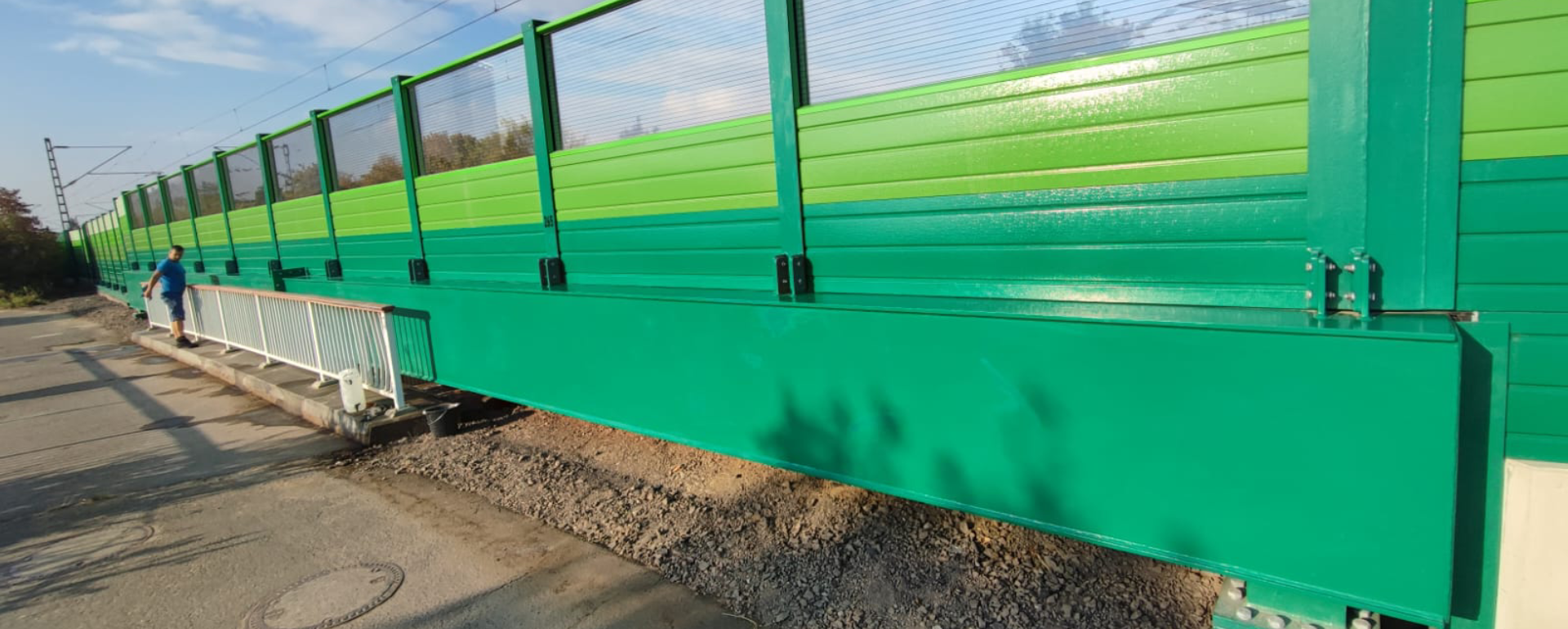
Steel erection is precision work with heavy material. A post one degree out of plumb is visible after ten elements. A bolt without its torque holds, until it does not. That is why torque wrenches and rotating lasers are standard kit here rather than something special.
We install onto cast-in anchor channels, onto anchor cages and onto post-installed bonded anchors. Where the foundation is not exactly right, it gets packed out with shim plates instead of forcing the component into position.
Steel posts for noise barriers, fencing and cladding, in sockets, on base plates or in bored piles. Spacing, plumb and level get surveyed and then rechecked post by post.
Wall brackets, pipe clamps, cable trays and service supports on concrete and steel. Set out the drilling pattern, place the anchors, take up the load, torque them.
Bolting onto cast-in anchor channels and anchor cages, with hammerhead bolts or threaded rods. Level and position deviations packed out with shim plates and grout.
Masts, cantilever arms and mounted equipment inside the rail corridor, installed during the possession to the client specification, with earthing connection and equipotential bonding.
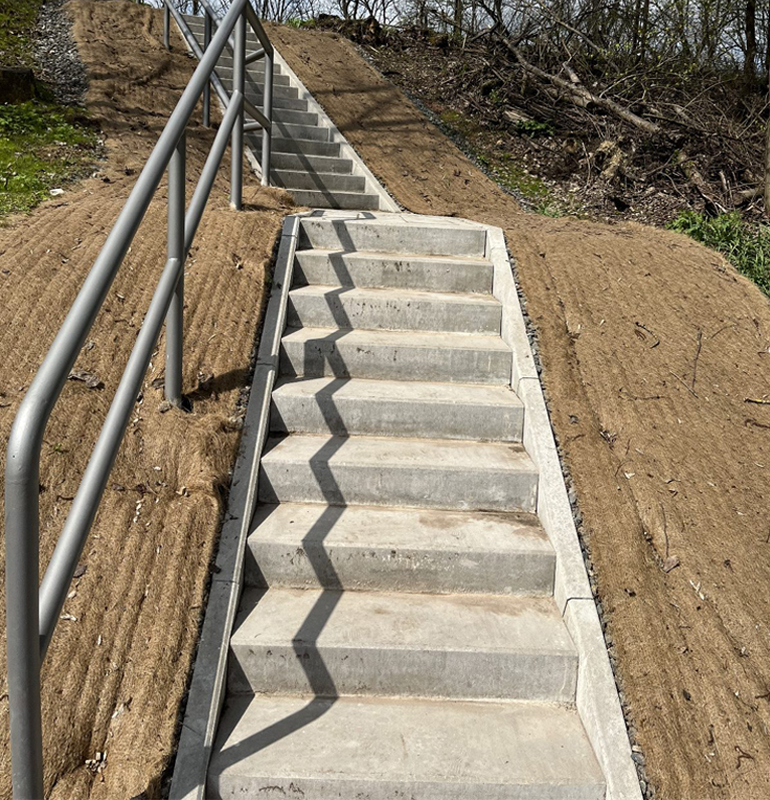
Railings, handrails, grating, platforms and stair flights. Bolted, aligned and checked for gap widths, because on a railing everyone can see it.
Steel frames for enclosures, gates, cladding and plant areas, including alignment in both axes before anything is tightened.
With post-installed anchors the load capacity is created in the hole, not at the bolt head. Drilling goes to the depth the approval states, then the hole is blown out and brushed until no dust is left. Skip that step and a substantial part of the pull-out load goes with it, and from the outside nobody can see it.
Then comes the resin, then the anchor, then the curing time from the data sheet. Only after that is anything torqued. That time is planned into the installation day and does not get cut at the end because a truck is waiting.
Every connection has its tightening torque, and an impact wrench does not know it. We torque with a calibrated wrench and, on request, record position, anchor type, drilling depth and torque for each connection.
For the client that is more than paperwork: at a later inspection or in a damage case it is traceable what was installed. We name this service in the quote rather than writing it up afterwards as a variation.
Galvanised and coated components arrive on site finished. Every scratch down to bare steel is a place where rust will show in five years. We move and lift with clamps, slings and edge protection rather than chains.
Where drilling, sawing or cutting has to happen on site, the cut edge gets treated to specification afterwards. We document touch-ups with a photo, so nobody at handover has to guess whether the spot was treated.
Installation drawing, bolt list and the details on anchors and torques. We check whether the connections can be installed the way they were drawn.
Position of anchor channels, concrete strength, edge distances and reinforcement position where relevant for post-installed anchors. Deviations in writing before we start.
Drill, clean, set the anchor, wait out the curing, align the component, pack out with shim plates, torque with the wrench.
Plumb, line and gap widths checked, torque record on request, photo documentation and handover.
Our focus is bolted and anchored connections. Site welding with procedure qualification and certification is better placed with a certified welding contractor. We then install onto or around that work.
Yes. Night and weekend work in possessions is part of our routine, including earthing connections and equipotential bonding on masts and wall elements. Lookouts and the possession itself are arranged by the client; we size the crew and the quantity per shift to the window.
Then we report it before the first lift, with a measurement and a photo. Depending on the deviation it gets packed out with shim plates and slotted holes, or a post-installed anchor is set where the structural design allows it. What does not happen: forcing the component into position.
On request, yes, for each connection with position, anchor type, drilling depth and applied torque, plus progress photographs. Say so in the enquiry and it will be in the quote.
Yes, where the travel day pays for itself or the work can be bundled with other positions at the same location. For a single bracket two hundred kilometres away a local contractor is cheaper, and we will say so.
Slings, spreader beams, clamps and small plant we bring. Crane and mobile excavator come from the client or through our partner firms with a certified operator, by the day, for exactly the days they are needed.
Most sites need more than one of these. One crew then covers both, with no interface between two companies.
Free-standing panels with absorber cassettes for sites, generators and event grounds. Erection, relocation and dismantling by one crew.
Retaining units, wall panels, columns and plinths: lifted straight off the low loader, placed, levelled and anchored.
Old barriers, precast units and steel structures taken apart, separated by material and stacked for collection.
All twelve installation services on one page, from post setting to material transport.